


Overview
The sixth-generation Toyota RAV4 has a lot to live up to.
To match its predecessor in the Australian market, the latest iteration of Toyota’s mid-size SUV must be among the best-selling vehicles in the country.
With 51,947 examples sold in 2025, the RAV4 was Toyota’s key model in Australia along with being the second best-selling vehicle sold locally overall.
It also topped the sales charts for non-ute models.
But the RAV4 isn’t just a top performer in Australia; it also finds itself placed among the best-selling models globally.
So, no pressure then…
However, the “all-new” RAV4 actually isn’t as new as you’d think; with Toyota adopting an if it ain’t-broke-don’t-fix-it approach and continuing to use the same TNGA: GA-K platform as its predecessor.
Like the last generation hybrid model, the new RAV4 HEV’s powertrain consists of a 2.5-litre four-cylinder petrol engine, a front-mounted electric motor (along with a rear-mounted electric motor in the case of the AWD variants), and an e-CVT transmission. Toyota quotes a combined system output of 143kW in both two-wheel drive and all-wheel drive configurations.
This output figure is 17kW lower than the outgoing RAV4 2WD and 20kW down on the outgoing AWD model, due to the need to comply with Euro 6d emissions standards.
The 2WD models complete the run from 0-100km/h run in eight seconds, while AWD variants make the dash in 7.7 seconds.
Claimed combined fuel economy is 4.5 litres per 100km in 2WD configuration and 4.6 litres per 100km in AWD form.
Perhaps the biggest change to the RAV4’s line-up for its sixth generation is the addition of a plug-in hybrid powertrain option – with deliveries expected in Australia in Q3 2026 – consisting of a 2.5-litre petrol engine, with either a front-mounted electric motor or dual-motor all-wheel drive, and a 22.7kWh lithium-ion battery.
In 2WD form, it produces 201kW while AWD models have a combined system output of 227kW, the highest power output ever for a RAV4.
The battery supports 11kW three-phase AC Charging and 50kW DC charging.
Toyota is yet to officially quote an electric-only range for the plug-in hybrid model, but GoAuto understands that the development target is at least 100km on the WLTP cycle.
The new RAV4 range model line-up comprises 11 different variants.
The HEV range comprises the GX 2WD (priced from $45,990 before on-road costs), proceeding through to the GX AWD ($49,340), GXL 2WD ($48,990), GXL AWD ($52,340), Edge AWD ($55,340), XSE AWD ($58,340), Cruiser 2WD ($56,990), and the Cruiser AWD ($60,340).
Meanwhile, the plug-in hybrid range starts from $58,840 + ORCs with the XSE 2WD PHEV, XSE AWD PHEV ($63,340), with the range topped by the flagship GR Sport AWD PHEV variant ($66,340).
Compared with the last-generation, the entry-price for the RAV4 Hybrid range has risen by $3730 before on-road costs, which may tempt buyers into one of many cheaper, particularly Chinese rivals that have flooded the market since the fifth-generation model’s introduction back in 2019.
Standard features on the entry-grade GX variants include 17-inch alloy wheels, LED headlights, taillights and daytime running lights, roof rails, an acoustic windscreen, a 10.5-inch infotainment touchscreen, a 12.3-inch digital instrument cluster, fabric seats, manually adjustable front seats, five USB-C ports, a six-speaker sound system, and an embedded Drive Recorded dashcam function.
All-wheel drive GX examples also get Trail and Snow driving modes and downhill assist control.
Standard safety features include eight airbags, an autonomous emergency braking pre-collision system, full-speed adaptive cruise control, emergency steering assist, front and rear cross-traffic alert, lane trace assist, proactive driving assist, a rear parking support brake, blind-spot monitoring with safe exit assist, and a reversing camera.
The new-generation RAV4 launches in Australia without an ANCAP rating, although it is expected to achieve a five-star score under 2026 protocols when it is tested later this year following a safety update.
However, this means that pre-update examples will never hold an ANCAP rating…
Over the entry-grade GX, the GXL variant gets 18-inch alloy wheels, silver integrated skid plates, rain-sensing wipers, synthetic leather door and instrument panel trim, a leather-accented steering wheel and shift knob, an eight-way electrically adjustable driver’s seat with lumbar support, and a wireless phone charger.
The Edge AWD serves as a more rugged, soft-roader variant, arriving with a unique bumper and grille design, a 20mm wider track, wider wheel arches, 18-inch dark matte grey metallic alloy wheels, a 12.9-inch infotainment touchscreen, heated front seats, a netted cargo area side pocket, a power tailgate, synthetic leather seats, and metallic ornamentation.
Stepping up to the XSE AWD we find 20-inch alloy wheels, black front and rear bumpers with integrated silver skid plate at the rear, black exterior trim, two-tone paint, mid-grade LED headlights, a panoramic view monitor, leather and suede seats, heated, ventilated and power adjustable front seats with driver’s seat memory, storage tray illumination, and a tilting and sliding moonroof.
At the top of the hybrid range, the Cruiser variant comes with high-grade LED headlights, a shift-by-wire lever with an integrated parking brake, a heads-up display, a digital rearview mirror, heated outboard rear seats, a kick-sensing power tailgate, dual wireless phone charges, and a nine-speaker JBL sound system.
The XSE variant grade kicks off with plug-in hybrid range with an identical equipment list to the equivalent HEV model save for larger brakes, water-repellent front side windows, and a 1500W inverter in the boot as opposed to a 12V socket.
Finally, the flagship plug-in hybrid GR Sport variant gets unique 20-inch alloy wheel and front and rear bumper designs along with GR badging, red brake calipers, rear spoiler, the 20mm wider track from the Edge model grade, aluminium pedals, a heated GR steering wheel with paddle shifters, suede GR Sport knee pads, synthetic leather and suede seats, front performance dampers, stiffer suspension, a rear brace, and a unique power steering tune.
Toyota quotes a variant-dependent 705 litres of boot space.
All variants are equipped as standard with a space saver spare wheel with a full-size spare optionable for $300 in the GX models.
The new RAV4 is offered with five-year/unlimited-kilometre warranty as well as a five-year/75,000km capped-price servicing program for both HEV and PHEV variants, with service intervals coming every 12 months or 15,000km.
Each service is priced at $325 meaning maintenance costs for five years comes to a total of $1625.
Driving Impressions
Much of our RAV4 testing time was spent on Tasmania’s winding, technical roads complete with drastic elevation changes, broken up by brief urban stints and faster, flatter and more straightforward country roads.
Specifically, we tested the GXL 2WD and AWD, Cruiser 2WD and AWD, and Edge AWD variants, all in HEV form.
We’ll have to wait until later in the year at the very least to get behind the wheel of the new plug-in hybrid models.
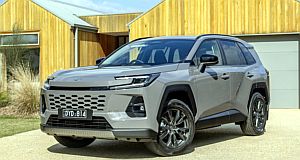
As far as exterior aesthetics go, the new RAV4 appears as a logical next step over the outgoing model while the design (particularly the front- and rear end) has been smartly modernised.
Until the GR Sport variant arrives, customers have the choice between the sleek design of the vast majority of the range or the boxy, more rugged appearance of the Edge variant. However, whichever you go for, both aesthetics work.
Inside, some immediate plastic touchpoints do feel a bit scratchy, but, while they certainly aren’t fancy, they aren’t offensive. The leather and synthetic leather surfaces found in some model grades feel very pleasant, too.
There’s a lot to like about the UX and UI…
There are physical controls for the media volume, demisting, air-conditioning temperature, and drive modes on the dashboard.
The physical steering wheel controls are also clear and easy to use. Fan speed controls (as well as seat heating and ventilation on certain model grades) are handled through a menu bar displayed on the bottom of the infotainment screen.
While we would prefer the quick adjustability of a conventional HVAC control panel, these controls are hardly a punishment.
The infotainment system itself – which is available in both 10.5 and 12.9-inch guises – is slick, crisp, and easy to navigate with its simple layout. Aside from being wireless Apple CarPlay and Android Auto compatible, it also has features like Spotify – which is available with a three-month free trial period and for $12.50 per month thereon out – integrated into the system.
There are plenty of practical storage options available in the front row of the RAV4 including large cupholders, decent door-bin storage, a slot in the dashboard to store smaller items and a sizable centre console armrest storage in which you’ll find a 12V socket and a USB-C port.
Speaking of the centre console armrest storage, the lid is removable and double-sided. On one side you’ll find a conventional armrest cover while on the other there is a flat plastic tray, useful as a storage option.
From the driver’s seat, both front and rear visibility is very strong, particularly forward visibility on account of the RAV4’s thin A-pillars and a strong view beyond the wing mirrors through the side windows.
The front seats are comfortable regardless of the trim level; however, we did find that they could use a little more side bolstering.
Rear seat passengers in the RAV4 enjoy impressive levels of knee room and good headroom, and while there’s a small transmission hump it’s not horribly invasive.
There are some useful amenities too including USB-C ports, rear air vents and a centre folding armrest as well as heated rear outboard seats on high-spec variants. However, the small door bins leave rear passengers short-changed on storage.
Aside from having plenty of room, the boot has some useful features, with the adjustable, double-sided boot floor being a particular highlight, which is plastic on one side, useful for storing something like a used wetsuit.
On the road, the new RAV4 is absolute joy regardless of the variant.
The ride is just right. It’s not too hard nor is it too soft, and it feels exceptionally well calibrated for Australian roads. The body control is also very composed.
Through the corners, the RAV4 is not only competent, but genuinely enjoyable to drive.
The steering is well-weighted and direct, making the RAV4 extremely easy to place, and there always seems to be an abundance of grip. On a twisty road, there’s very little that can truly unsettle the RAV4.
It’s also quiet in the cabin while on the move. Tyre noise isn’t really a problem and while wind noise can occasionally pick up at higher speed, with slight wind rustle around the wing mirrors, it’s far from too much.
As mentioned, all the vehicles present on the Australian launch of the RAV4 were equipped with the regular hybrid powertrain.
Despite having less power than its predecessor, and while its performance might not set the world on fire, the powertrain is responsive and in neither 2WD nor AWD configurations did the new RAV4 feel particularly underpowered.
Unsurprisingly, the powertrain does suffer from a bit of CVT drone…
Fuel economy during our time with the RAV4 varied, partly because of the differences between 2WD and AWD configurations, but also due to the nature of the roads during any given fuel run.
The worst fuel economy we recorded was 8.7 litres per 100km in the Edge AWD, although this was largely since we were travelling up-hill on high-speed, twisting mountain roads.
On a more relaxed drive on largely flatter country roads in the GXL AWD, the trip computer returned 5.2 litres per 100km.
When it comes to ADAS tuning, key systems such as the adaptive cruise control and lane centring work as expected. However, we did find the driver attention monitor system slightly too sensitive, telling you off for looking at the digital gauge cluster, another part of the cabin, or the outside scenery even for what felt like a split second.
Overall, perhaps unsurprisingly, the RAV4 is an extremely accomplished vehicle. It’s as dynamically competent as it is comfortable, its cabin layout and user experience are largely on point, its fuel efficient, and its practical.
This hardly seems like a revelation, but by getting the fundamentals correct, Toyota has built an excellent car. The new RAV4 delivers on everything we liked about the previous generation, but in an updated package.
While we’re yet to experience it, the plug-in hybrid option adds what appears to be yet another compelling choice to what is an already very desirable line-up.
There are a few minor gripes including, the over-reactive driver attention monitor, the lack of a physical control for the fan-speed, the slightly under-bolstered front seats and the CVT drone.
Furthermore, the lack of an ANCAP safety rating for many examples sold within the first year might deter some buyers, at least for now.
Also, a lot of features that arguably should be found in cheaper RAV4 variants are also limited to the higher model grades.
For instance, you’re halfway up the RAV4 pecking order in the Edge variant – priced at $55,340 – before you’ll find synthetic leather or heated seats. If you want a 360-degree camera or a moonroof, you’ll be forking out $58,340 for the XSE model.
Ultimately however, we believe that even with historically astronomical sales figures to live up to, the sixth-generation Toyota RAV4 carries the nameplate in safe hands.