

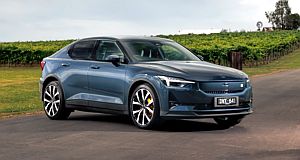

Overview
POLESTAR has launched its updated Polestar 2 into the local market with changes to the model range that include an upsized battery pack (now 82kWh), increased peak range (now 659km WLTP), faster charging capacity (now 205kW DC), and additional technologies that include a faster new central processing chip that offers greater HMI responsiveness.
Priced from an unchanged $62,400 plus on-road costs, the 2026 Polestar 2 is offered again in Single and Dual Motor configurations and in Standard and Long Range formats.
A new paint colour, Dune, joins the palette, while restyled alloy wheels, an impressive 14-speaker Bowers & Wilkins premium audio bundle, eco-friendlier MicroTech upholstery, and tinted rear glass all make their debut.
An evolved software bundle now offered in the Polestar 2 further allows the ability for users to access apps including YouTube, Prime Video, and Google Chrome.
The suite of updates come as Polestar Australia surpasses 6200 aggregate sales of the Polestar 2 (since 2021), and a year-on-year increase of 38.5 per cent across the model portfolio (2024 versus 2025). The Sino-Swedish electric vehicle brand has also grown its dealership presence in Australia in that period, growing to 11 locations nationally – and now with 23 service locales.
The 2026 Polestar 2 will enter the Aussie market as a rival to players that include the BYD Seal (from $46,990), Kia EV4 (from $49,990), and Tesla Model 3 (from $54,900), albeit with a more premium tilt.
Specifications see the Standard range Single motor (from $62,400) offered with 200kW/490Nm of output to the rear wheels with power drawn from a 70kWh lithium-ion battery.
Running 400-volt electrical architecture, the variant offers a 10-80 per cent charge time of 26 minutes when connected to a 180kW DC fast charger. AC charging takes seven hours when paired with an 11kW supply.
Polestar says the variant can accelerate from 0-100km/h in 6.4 seconds on its way to a top speed of 205km/h. Range is listed at 554km on the WLTP cycle.
Moving up to the Long range Single Motor (from $66,400), we find a step up to 220kW in output but with an identical 490Nm. The rear-wheel drive variant offers a larger 82kW lithium-ion battery pack offering comparable charge times to the Standard range Single motor.
The 0-100km/h standard is likewise covered in a comparable 6.2 seconds and top speed again capped at 205km/h. Range is listed at 659km on the WLTP cycle – making this variant the pick of the litter for those chasing the greatest distance between recharging.
All-wheel drive versions of the Polestar 2 begin with the Long range Dual motor (from $71,400). This variant offers a total system output of 310kW/740Nm and uses the same battery as the Long range Single Motor. The added performance on tap shrinks range to a still respectable 596km and hastens the 0-100km/h time by almost two seconds (4.5s).
Finally, for the flagship Long range Dual motor with Performance pack (from $85,080) we find a tweaked system output of 350kW (and still with 740Nm), an identical battery pack, slightly reduced range of 568km, and a 0-100km/h time of 4.2 seconds.
Both dual motor variants have the same top speed as the rest of the Polestar 2 pack (205km/h).
Standard inclusions across the Polestar 2 range include electrically assisted steering, two-piston front and single-piston rear brakes, a MacPherson strut and multi-link rear suspension arrangement, and wheel choices ranging from 19- to 20 inches in diameter (all with repair kit ‘spare’), depending on variant.
The Performance Pack adds Brembo four-piston brakes up front and cross drilled rotors at the rear, as well as Ohlins adjustable dampers.
Equipment highlights for the Polestar 2 range include a fixed glass panoramic roof, all-LED exterior lighting with Pixel LED headlights available optionally, keyless entry and start, rain-sensing wipers, a powered tailgate with kick sensor, heated front seats, semi-electric front seat adjustment dual-zone climate control, four USB-C outlets and one wireless smartphone charging pad, and 60:40 split fold rear seats.
On the infotainment front, we find inclusions such as wired Android Auto and Apple CarPlay connectivity, a 12.3-inch driver screen, 11.2-inch infotainment touchscreen, eight-speaker sound system, FM/DAB+ radio reception, and a suite of connected services technologies.
The Polestar 2 arrives as standard with an extensive driver assistance and safety list, highlights of which include eight airbags, adaptive cruise control, autonomous emergency braking, blind-spot monitoring, cross-traffic alert, front and rear parking sensors, lane departure and keeping assistance, road sign recognition, speed limiter function, trailer stability assist (for trailers up to 1500kg), and an available 360-degree camera system.
A range of extra packs and accessories remain available.
Polestar offers a five-year vehicle warranty and eight-year traction battery warranty on the Polestar 2. Roadside assistance is included for the duration of the vehicle warranty, while servicing intervals are set at two years or 30,000km (whichever comes first).
Driving Impressions
The Polestar 2 remains unchanged in many respects from the vehicle we sampled last in 2024. It has the same quibbles we’ve noted previously – a slightly peculiar driving position, compromised rear-seat accommodation, and slightly firm ride – but by the same token remains a joy to drive, and a stunner to look at.
We found the ‘get-in-and-drive’ simplicity of the Polestar 2 a welcomed change to some now in the market, the human-machine interface and primary controls seeming more logical now than when we first examined the model back in 2021. It’s an indication that Polestar may have been on the right track all along…
Our test drive through the twists and turns of the hills surrounding Healesville shows equally just how sorted the Polestar is dynamically. Yes, the electric steering is a little synthetic in its feedback, but its accurate enough once you get yourself ‘dialled in’.
The vehicle tracks cleanly for a car weighing close to 2000kg and is rich in natural grip. Cornering is flat and predictable, requiring very little input midway. We found we could push the Polestar 2 hard into corners and accelerate out effectively, all before any indication of electronic intervention is noted.
For those reasons, it is no surprise the Performance Pack is even sharper. The manually adjusted Ohlins dampers are keenly set to resist the inputs of a poorly kept surface while simultaneously allowing the body to move on its springs with GT-car-like comfort.
It’s the Polestar 2’s combination of ride and handling that very few EVs can hope to match, giving the car a clear advantage over the point-and-shoot straight-line heroes in its class.
Acceleration, of course, is as brisk as the numbers would have you believe and is wonderfully well metered through a sensibly calibrated pedal and phenomenal electronics. While we’re sure the vehicle is processing every input in magnificent detail, the result is so fluid, and so free of wasted wheelspin, that you’ll never really know it.
Sure, there are quicker competitors in the class, but they don’t have the breadth of abilities offered in the Polestar 2. This is a car that is easy to drive smoothly – and just as easy to drive quickly. It’s a car that doesn’t fight against your commands, and that seems to enjoy a spirited run as much as we do. Perhaps EVs aren’t the end of enjoyable driving after all…
With all of that said, we hasten to add a couple of points about the Polestar 2’s braking. Like many EVs, the brake pedal is a little wooden and lacks some of the modularity required in more complex scenarios. Using the regenerative ‘brakes’ can help to a degree, but we still feel there is more finesse to be found from the Brembo-sourced stoppers.
We’ll be very keen to sample the updated ‘2’ in a less dynamic setting to see just how it feels as a daily driver. Time spent previously with the vehicle tells us it’s a good one that has obviously benefitted from a mid-life update, and with great credit to Polestar at no extra cost.
Would we buy one? You betcha. Just how we’d configure it though is a question for another day – because as thrilling as the all-wheel drive Performance Pack is, there is no discounting the rear-driven Long range Single Motor. Optioned with a few extra goodies, we think it might just be the pick of the bunch.