


The Renegade 4xe also has a smaller tank of fuel than the eHybrid to accommodate the larger plug in battery. The car’s range will be significantly reduced if the battery is not charged when the vehicle is parked. Either way, stops are going to be frequent to top up either the battery or the fuel tank.
| Model | MPG | CO2 | Insurance group |
| Renegade 1.5 E-Hybrid | 52.3mpg | 127g/km | 17 |
| Renegade 1.3 4xe PHEV | 134.5mpg | 48g/km | 26 |
Electric range, battery life and charge time
While the battery in the 4xe PHEV is small at 11.4kWh, that does mean it’s quick to top up when compared with a full EV. It can go from flat to fully charged in an hour and 40 minutes when plugged into a 7.4kWh wallbox, but that’s as fast a charging speed as you’ll get, because there are no quicker options available.
| Model | Battery size | Range | Insurance group |
| Renegade 1.3 4xe PHEV | 11.4kWh | 30 miles | 26 |
Insurance groups
The complexity of the plug-in powertrain has a negative effect on insurance group ratings. The e-Hybrid model falls into group 17, but the 4xe is nearly 10 groups higher in 26.
Tax
All versions of the Jeep Renegade fall below the PS40,000 luxury car surcharge for road tax, so the 4xe will be a cheaper car to run than many other four-wheel-drive SUVs.
Depreciation
There’s a retained value of around 43 per cent for the e-Hybrid version of the Renegade, which is at the lower end of the spectrum in the small SUV class, but not shocking. The 4xe has a residual value of just 37 percent, which is a pretty low number. This isn’t the worst performer in the Jeep line-up, though, because the Compass has even less impressive residuals.
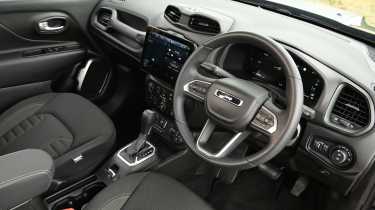
Ageing interior will appeal to some because of its switches, but they’re not well laid out
Pros |
|
Cons |
|
The Renegade’s cabin was designed back in the early 2010s, so it looks quite dated today, and features plenty of hard plastics. The Renegade has many physical controls, rather than touchscreens, and this can be a plus for some. The controls on some models are not logically arranged, and the fuel filler on the PHEV looks like an aftermarket accessory. It’s actually a safety measure to avoid opening the fuel cap while the car’s charging, which can cause a fire. As well as the touchscreen and climate controls, a third bank of switches sits beneath the climate settings to change the off-road modes.
Interior and dashboard design
Inside, Jeep squeezes in plenty of character touches. The Jeep face of round headlights, seven-slot grille and speaker surrounds are embossed on the rear-view-mirror housing, tailgate and speaker surrounds. The air vent design is apparently inspired by base-jumping equipment, the pod-like central vents by ski goggles, and you even get a mud splatter graphic instead of a red line on the rev counter.
Materials and build quality
Hard plastics are the order of the day, but as with other off-road biased models, the Renegade makes a virtue of this and incorporates it into the design.
Infotainment, sat-nav and stereo – subhead H3
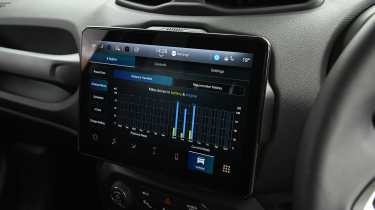
There’s a modest 10-inch touchscreen inside, while the driver gets a 10.25-inch display ahead of the steering wheel that shows loads of information. The main screen has plenty of functionality, with Bluetooth included alongside Apple CarPlay and Android Auto, allowing you to bypass the native infotainment system if you want.