

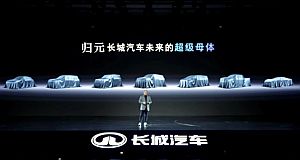

GWM has taken the concept of platform sharing to another level, unveiling its ‘ONE’ architecture that will underpin as many as 50 models with hybrid, hydrogen, battery-electric and ICE powertrains planned.
Marketing-approved GWM logic for the system is: “one vehicle, multiple powertrains; one vehicle, multiple categories; one vehicle, multiple configurations; one vehicle, multiple markets”.
Reflecting attempts by global car-makers to reduce development and manufacturing costs across entire product line-ups, GWM appears to have gone further with a one-size-fits-all platform that can be adapted to virtually any vehicle segment or propulsion method.
The platform will have both ladder-frame and monocoque chassis options, and these will be compatible with an array of powertrains ranging from internal combustion to electric and hydrogen fuel cell, with various flavours of hybridisation.
“It may sound dynamic and complex, but in reality they simplify complexity,” said GWM chair Jack Wey.
“Thanks to multiple powertrain options, we have expanded our market reach.
“For example, it can be equipped with large-displacement gasoline engines to meet the demands of the Arab markets.”
An example of these so-called large-displacement engines could be the menacing twin-turbocharged V8 hybrid powertrain GWM revealed at the Shanghai Motor Show and again more recently at CES in Las Vegas.
Whether the force-fed 4.0-litre V8, rumoured to produce 403kW on its own and almost double that when coupled with electric motors, will make it into ONE-based models is yet to be established – but it sounds likely.
GWM’s ONE platform is also reported to use a vision-language-action artificial intelligence model to manage powertrain, dynamics and driver-assistance systems.
These AI systems will be used to predict hazards, adjusting suspension, steering and braking during “emergency avoidance”, meaning a less reactive safety response.
“The GWM ONE platform shatters the traditional boundary between active and passive safety, achieving a deep integration of the two” said GWM chief executive Mu Feng.
“Safety is no longer about reacting to a crash, but about predicting and protecting at every stage.”
More bizarrely, the AI apparently also coordinates the lighting and seats to deliver “romantic” scenario-based experiences…whatever that means.
GWM has so far teased one car – albeit in camouflage form – set to use the new platform, in the form of a large 5.3-metre SUV that will fall under its premium Wey brand in China.
Chinese media reported the model will use a 2.0-litre turbocharged engine with 800-volt plug-in hybrid system, capable of a pure-electric range of around 400km with the ability to recharge at a rate of 200km in just five minutes.
Locally, GWM achieved record sales across 2025 totalling 52,809 vehicles to make it the seventh most popular brand in Australia.