

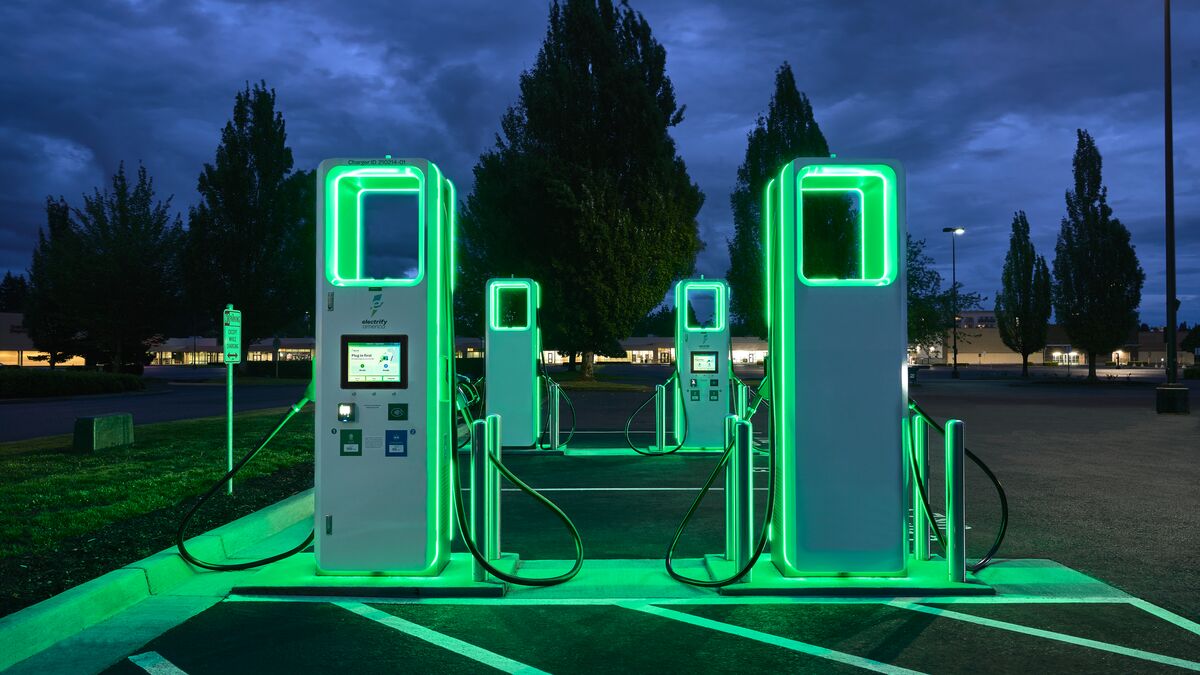
Quick Facts About Electric Vehicle Charging Stations
- Download the apps for charging stations you’ll use locally and when you travel.
- Smaller electric vehicle (EV) batteries can charge to capacity faster than larger batteries.
- You might find free chargers, but paid charging stations are much more common.
One of the most significant differences between owning an electric vehicle and a gas vehicle is that EVs require charging. Charging speeds have improved over time, making it much more convenient to stop off for a quick charge, but the reality is that EVs still take longer to “refuel” than their gas-powered counterparts. We recommend a home charger for any EV owner, but public chargers give drivers the ability to “juice up” on the road.
If you’re wondering about the different types of chargers, how much it costs to use a public charger, or what’s involved with using them, we’ve got answers. Let’s get into what you need to know about charging an EV at home or on the go.
RELATED: How much does it cost to charge an EV?
Electric Car Charging Station Location Apps
While having a home charger makes EV ownership much less of a hassle, many people don’t have that option. Even for those who do, there will be times when they’ll need to charge away from home. The good news is that the number of public charging stations has grown over the last few years, though they are far more readily available in major metro areas and along the coasts.
The navigation systems in most new EVs can locate public chargers, either nearby or along a planned driving route, but one of the best ways to find an available charger is by using one of the popular apps on the Apple App Store or Google Play Store. It might seem more convenient to use the in-car solutions first, but apps generally offer real-time information on charger availability, speeds, and pricing.
Almost every charging company has its own app, but PlugShare is a good alternative. It relies on crowdsourced information to update charger availability and speeds, and it’s often more accurate than the individual apps at identifying chargers that are under maintenance or locations that are no longer open. PlugShare also works with in-vehicle services like Apple CarPlay and Android Auto, making it easier to access that data on the go.
The ChargePoint app is another good option, and it’s sometimes rated as being more user-friendly than competing interfaces.
That said, you might be required to have an account with some charging companies to access streamlined payments or the chargers themselves. You may also have more payment options or additional benefits through your EV manufacturer’s app.
Are EV Charging Stations Free?
Some public charging stations are free, especially at businesses, schools, and libraries, but the vast majority charge a fee. Most bill by the kilowatt-hour (kWh), but those rates vary widely from state to state. Click through the interactive tool below to view charging statistics for each state.
Types of Electric Vehicle Charging Stations
Source: U.S. Department of Transportation.
Charger speed matters, but the size of the battery you’re trying to charge is a significant part of the equation. Battery technology also plays a role, as some newer models have preconditioning systems that help heat or cool the battery to the optimal temperature for the fastest, most efficient charging session. Environmental factors, such as ambient temperature, also affect charging speeds.
While some EVs can charge at 350kW or more, it’s important to note that charging the last 10% can take as long as the first 90%. It’s also good to remember that frequent, exclusive use of fast chargers can contribute to a faster decline in battery health, though advanced battery management software in many new models helps mitigate the worst of those effects.
MORE: Electric Car Range: Everything You Need to Know
Charging Station Reliability
Pulling into a filling station that’s unable to pump gas is an uncommon situation. Unfortunately, finding an EV charging station that’s out of order is not newsworthy. A study from the University of California, Berkeley, found significant reliability issues with fast chargers in the Greater Bay Area.
Charging networks claim uptime rates of 95% and higher. However, the study found that almost 23% of 657 DC fast chargers in the nation’s biggest EV market were nonfunctional. The chargers were out of order because of “unresponsive or unavailable touchscreens, payment system failures, charge initiation failures, network failures, or broken connectors.”
Unlike their gasoline counterparts, EV charging stations rarely have an attendant to monitor the equipment and keep it operational. As a result, the public charging infrastructure has plenty of room for improvement.
Tesla’s Supercharger network is generally regarded as one of the most reliable in the country, boasting 96-99% uptime rates. Many non-Tesla EVs can access the network with adapters, and new models have the plugs already built in.
RELATED: My First Time Charging an EV
How to Use a Car Charging Station
Most public EV charging stations will require you to first sign up for an account. These networks will store your credit card on file and typically give you a card to wave in front of the charger to activate a charging session. Hint: Keep that card in your glove box or center console.
From there, charging couldn’t be easier — or cleaner.
- Pop open the vehicle’s charging port
- Grab the charger from its holster
- Plug in, and walk away for a while.
Pro Tip: Find a charging station near a restaurant or coffee shop, in case you need to whittle away time. Read about taking an EV road trip and get tips.
A display at the charging station will show you how much electricity (and how much money) you’ve added to your electric car. And there will be a clearly marked phone number you can call if you have any questions or need assistance.
Most public charging stations deliver Level 2 power, adding 25 miles per hour to a Chevrolet Blazer EV, for example. Level 3 chargers, or DC fast chargers, provide much more power but cost more to use.
Tesla’s Supercharger network offers DC fast charging via North American Charging System (NACS) plugs. Superchargers have a reputation for reliability and often provide a better user experience than some leading third-party charging brands. Many of the newest non-Tesla EVs come from the factory with NACS plugs installed, giving them access to the Supercharger network. The downside is that they require an adapter to charge on other companies’ networks and most home chargers.
Charging Where You Park
Home and work are the most convenient places to top off — and a Level 2 setup at home is the gold standard. Here’s what it takes and what it costs.
240V Outlet Install
~$250
Average for a basic install. Older homes or longer wiring runs can add up.
Level 2 Charger
$400–$700
Plugs into your new 240V outlet. Longer-cable models are available.
Get 240V Power
Either a 240V outlet for a plug-in charger – the same type used by many electric clothes dryers – or set up a hardwired connection. Installation is easiest in a private garage or driveway near where the car parks.
Pick a Charger
Choose a Level 2 unit and order a longer cable if you need to reach a car parked outside the garage.
Plug In and Charge
The charger connects to your 240V outlet and to the car. Top off overnight while you sleep.
💡 Worth checking
Many new homes are pre-wired for EVs, and local incentives or discounted electricity rates may cut your costs further.
⚠ Apartment or street parking?
Cables across sidewalks usually aren’t allowed, and shared garages typically can’t be retrofitted — you’ll likely need a public charging plan instead.
Editor’s Note: We have updated this article since its initial publication.