

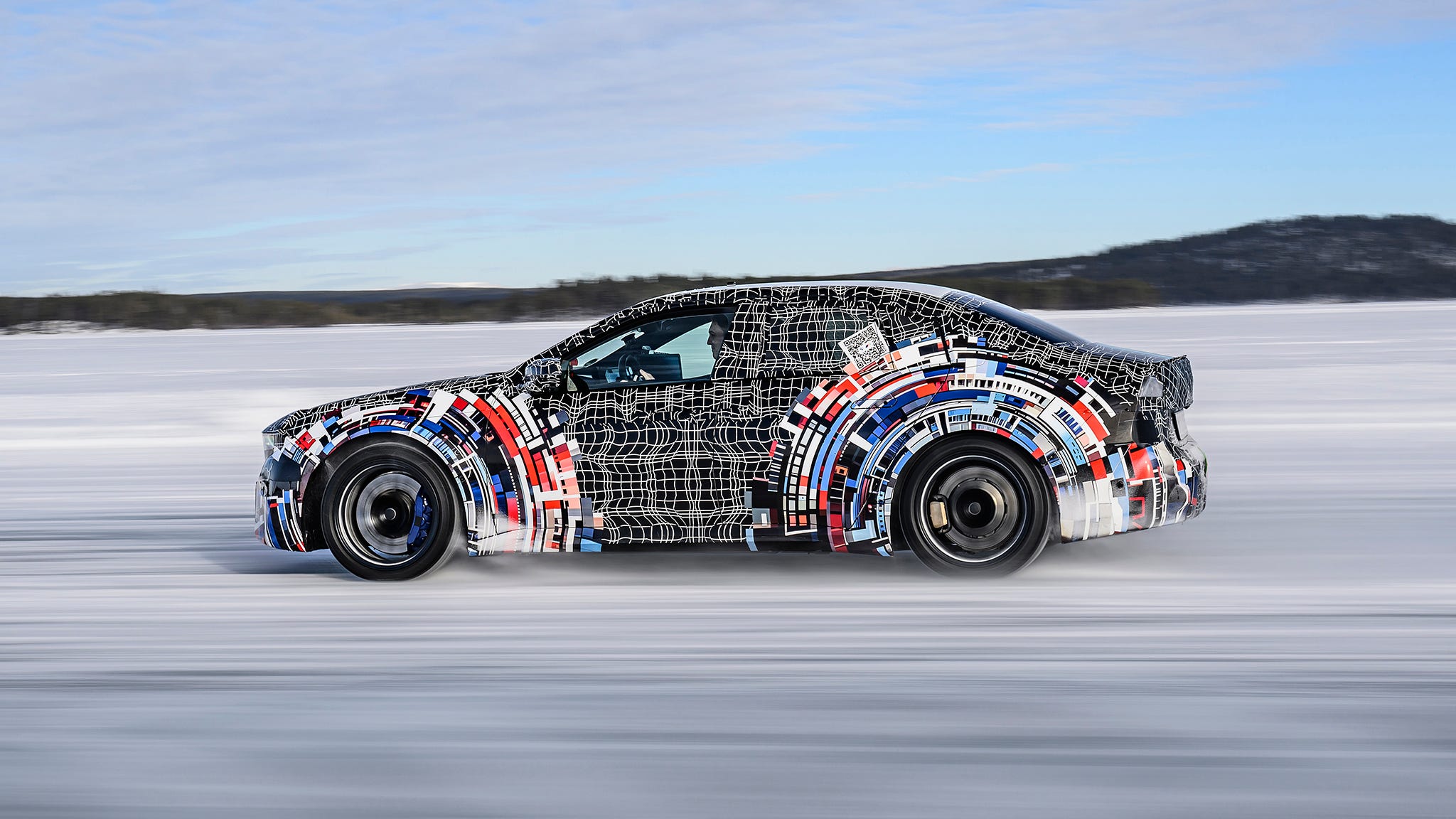
This motor type tends to be considerably cheaper to build. It’s also lighter and somewhat smaller while nearly matching the freewheeling efficiency of an EESM when no torque is required. Finally, these motors are powered by silicon-carbide (SiC) inverter technology. Altogether, BMW says the sixth-gen motor setup reduces energy losses by 40 percent, manufacturing costs by 20 percent, and mass by 10 percent.
Better Public Charging Experience
The big numbers—800-volt architecture capable of 400-kW DC fast-charging speeds, good for adding up to 230 miles of range in as little as 10 minutes—are just the foundation. BMW also seeks to eliminate the pain points of trip planning and charging through AI-based improvements to its MyBMW app’s route-planning service. By sensing and reporting actual (not claimed) maximum charge rates at various stations as reported by users, charging-time prediction accuracy is continuously improved, and by fine-tuning charger locations based on where cars actually plug in, drivers won’t find themselves searching a location for the plugs. The app will also predict the cost of charging at various locations and handle billing. (These features are rolling out to all BMW EV owners in 2026.)
ADVERTISEMENT – CONTINUE READING BELOW
Bi-Directional and Home Charging
All Neue Klasse vehicles will be capable of exporting power—either 3,600 watts of glamping juice via a three-outlet power strip that plugs into the NACS socket or 19.2 kW worth of whole-home power when connected to a properly wired BMW Wallbox Professional system. Vehicle-to-grid capability will be available in Germany at launch, and BMW says its customers could see an annual benefit of as much as 250 euro simply for allowing the grid access to the power in their batteries (respecting the customer’s preset minimum state-of-charge settings). V2G compliance for other regions will follow.
Bottom-Line Sixth-Gen Electrical Efficiency
Add up the reduced motor and inverter losses and the improved battery efficiency, then figure in the iX3’s sleek aerodynamics, and BMW is claiming a driving efficiency of 15.1 kWh/100 km. That boils down to 4.1 miles/kWh in quasi-American terms. For reference, over two years and 30,717 miles of use, our Tesla Model Y—long a paragon of electric SUV efficiency—averaged 3.1 mi/kWh. We very much look forward to a long-term test of what BMW casts as its most significant new vehicle line since the 1960s.
ADVERTISEMENT – CONTINUE READING BELOW