

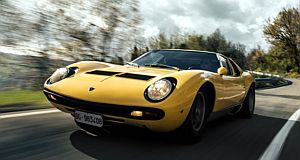

LAMBORGHINI has commenced year-long celebrations of its Miura supercar, which celebrated its sixtieth anniversary on 10 March.
Introduced at the 1966 Geneva Motor Show, the Lamborghini Miura P400 redefined high-performance motoring with not only an iconic design – penned by legendary Italian designer Nuccio Bertone – but with a set of specifications that seemed otherworldly at the time.
Fuelled by four triple-barrel Weber carburettors, the Miura’s transversely mounted V12 engine displaced just 3929cc. It featured a 60-degree bank angle and, unusually, a crankshaft that spun anticlockwise. The unit delivered an impressive 257kW of power at 7000rpm and 355Nm of torque at 5000rpm.
Paired with a five-speed manual gearbox and driving the rear wheels, it was claimed to accelerate from standstill to 100km/h in just 6.7 seconds and on to a top speed of 274km/h.
As the first production car in the world to feature the combination of midship engine and steel spaceframe chassis (weighing just 120kg!), the Miura P400 tipped the scale at just 985kg (kerb), helping it to not only out-perform much of its competition, but also deliver unrivalled handling and impressive braking.
Automobil Lamborghini president and CEO Stephan Winkelmann says the Miura was not simply another car, but a statement of intent for the young company.
“The Miura did more than introduce a new car – it changed the course of automotive history,” said.
“With its revolutionary architecture, breathtaking design, and uncompromised performance, it defined the very concept of the supercar and set Lamborghini on a path of fearless innovation.
“The Miura embodies our DNA: bold, visionary, and always ahead of its time.
“As we celebrate this anniversary, we honour a masterpiece that continues to inspire us – not only by looking back, but by reminding us that true innovation is born from the courage to challenge conventions.”
The Geneva show car was presented in Rosso Arancio (a reddish orange colour) paint, just one in a dazzling palette of vivid 1960s colours Lamborghini would offer.
Along with variations in wheels, tyres, trim, dampers, and even fuel tanks, the Miura would go on to sell 274 examples between its launch and April 1969, when the updated P400 S was introduced.
The Miura P400 S upped performance to deliver 276kW (now at 7500rpm) and 388Nm (now at 5500rpm), delivering a faster 0-100km/h time of 6.4 seconds, and increased top speed of 280km/h.
The vehicle was heavier than before (now 1180kg), and included a wider wheel track, a more luxurious cabin (with available air-conditioning and electric windows), ventilated disc brakes front and rear, a redesigned dashboard, seats, chrome brightwork, and reshaped air intakes.
In its third and final iteration (1971-73), the Miura P400 SV upped the power delivery from its V12 engine once more, culminating in 287kW at a lofty 7850rpm, but still with 388Nm at 5500rpm.
With a 0-100km/h time of just 5.5 seconds, and a published top speed of “over 290km/h”, the Miura P400 SV was one of the fastest production cars on the planet in its day – in spite of a now 1285kg kerb weight, widened rear axle, limited slip differential, and even more luxurious cabin appointments.
With a price tag of over 8,000,000 Lira in 1971, the Lamborghini was an expensive vehicle by any stretch of the imagination. By way of contrast, a Fiat 500 cost just 475,000 Lira at the same time, reserving the Miura to customers with ample means.
Between 1966 and 1973, the Lamborghini factory in Sant’Agata Bolognese produced 763 examples of the Miura, around 400 of which are estimated to survive to this day.
Depending on the configuration and condition of a surviving example, a Lamborghini Miura can today be expected to fetch as much as $A3,550,000.