

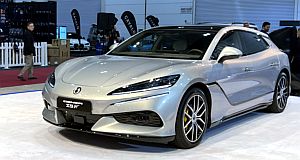

MELBOURNE played host to one of the largest motor shows in recent memory last weekend, the three-day event featuring more brands over more floor space than previously, attracting record crowds.
In terms of scale and public interest, it was reminiscent of the last Australian International Motor Show to be held at the Melbourne Convention and Exhibition Centre (MCEC) back in 2011.
Organisers estimate that as many as 120,000 visitors attended the sold-out three-day event (up 45,000+ from 2025), doubling its previous footprint by using all 20 MCEC bays.
Primarily centred on Chinese new energy manufacturers – including BYD, Denza, Farizon, GAC, Geely, GWM, JAC, MG Motor, Polestar, Smart, and Zeekr – the event was balanced by more established players that included Harley Davidson, Honda, Isuzu Ute, Kia, Renault, Skoda, Tesla, and Volkswagen, alongside dozens of aftermarket suppliers, car clubs, and automotive accessory vendors.
In a boon for crowds, the 2026 Melbourne Motor Show also hosted the Australian public debut of several new models from a wide range of brands, the highlights of which we have included below.
Some brands also brought in models sold in other markets and under consideration for Australia, displaying them to gauge public reaction.
Denza Z9GT
Powered by BYD’s next-generation Blade Battery 2.0, the Denza Z9GT offers ‘Flash’ ultra-fast charging (available only at selected Denza dealerships at launch) that will offer peak DC charging of 1500kW, enabling a 10-97 per cent charge time claim of just nine minutes.
For the flagship battery electric version coming to Australia, driving range is listed at 820km and system output 850kW via a three-motor, all-wheel drive configuration. Denza also produces not-for Australia plug-in hybrid and a rear-drive options.
The Denza Z9GT is said to accelerate from 0-100km/h in a claimed 2.7 seconds, and rides on DiSus-A air suspension that is said to offer grand touring levels of ride comfort and handling confidence.
Inside, the cabin décor pays tribute to “centuries on Chinese mastery in exquisite design” and includes highlights such as Nappa leather upholstery, massaging seats, a 50-inch segmented head-up display, Devialet premium audio bundle, and 128-colour LED ambient lighting to name but a few.
“The Denza Z9GT proves the electrification can deliver not just efficiency, but exhilarating performance, extraordinary safety, and genuine long-distance usability,” said Denza Australia chief operating officer Mark Harland.
Pricing and further specifications will be revealed when the model goes on sale in Q3 this year.
IM Motor LS9
Touted as a large, high-technology, luxury large three-row SUV, the IM Motor LS9 demonstrates “the future direction of intelligent electric mobility” for MG Motor’s premium brand.
The LS9 is offers highlights such as four-wheel steering, lidar-based advanced driver assistance systems, artificial intelligence computing platforms, and “high-level automated driving features”.
An 800-volt electrical platform pairs with dual electric motors and a range-extending petrol engine to deliver an output of 390kW/670Nm and driving range of up to 1500km on the more lenient CLTC scale.
Inside, the LS9 is said to emphasise a “highly digital and premium cabin experience” with large, integrated displays, advanced connectivity, and “luxury seating configurations” that are designed to position the model as a “flagship technology showcase”.
Geely EX2
Offered with complimentary home charging equipment, the EX2 will join the EX5 (electric) and Starray EM-i (plug-in hybrid) medium SUVs in Geely’s expanding local line-up and is offered with a choice of six paint colours, a single electric motor, rear-wheel drive dynamics, a sophisticated multi-link rear suspension layout, and efficient liquid cooled battery.
While specifications and pricing are yet to be announced, the model is expected to be competitively placed to take on similar-sized entrants from Chinese importers, including those of the BYD Dolphin, GAC Aion UT and MG 4 Urban.
Zeekr X
Zeekr revealed full specifications and pricing for its updated ‘X’ compact SUV ahead of the model’s May launch, the battery electric crossover positioned as “one of the strongest value offerings in the segment”, according to its manufacturer.
The five-seat Zeekr X is priced from $48,900 drive-away ($8000 less than when the X launched Down Under in September 2024) and offers the choice of rear- or all-wheel drive configurations delivering 250kW and 365kW of output respectively, and a driving range of up to 415km on the WLTP cycle.
Standstill to 100km/h acceleration times for the duo are listed at 5.6 seconds and 3.7 seconds respectively, with an improved Golden Battery (LFP) pack optimised to offer 230kW DC fast charging for a 10-80 per cent charge time claim of just 18 minutes.
The Zeekr X is said to deliver a “richer suite of in-cabin convenience and technology” introducing previously optional features as standard.
These include heated first- and second-row seats, inductive steering wheel controls, a 13-speaker Yamaha surround sound audio system, and, on the AWD variant, massaging front seats plus an on-board fridge.
With more advanced safety and driver assistance technologies than before, Zeekr Australia managing director Frank Li says the Zeekr X looks set to make its mark in a highly competitive segment, without asking a premium for the privilege.
“Our customers have embraced the Zeekr X for its design, intelligence, and everyday practicality,” he said.
“With the new model, we’ve added more performance, faster charging, and more features and standard, while keeping pricing competitive.
“It offers genuine luxury EV credentials without pushing beyond what buyers expect to pay.”
Volkswagen Tayron and Tiguan eHybrid
Available in Elegance and R Line grades, the plug-in hybrid SUV duo is around $2000 and $3000 pricier than their petrol derivatives but offer fuel-saving 1.5-litre petrol-electric drivelines outputting 150kW and 200kW respectively and offering a combined cycle fuel consumption figure of as low as 1.6 litres per 100km.
Electric-only driving range is listed at 113km and 117km for the pair, while rapid DC charging is rated at up to 40kW, allowing a 10-80 per cent top-up of the 19.7kWh battery in around 30 minutes.
The front-wheel drive pair is available in five-seat format only, owing to the placement of the high-voltage battery pack.
Initial customer deliveries are expected imminently.
Farizon V7E and F3E
Importer Jameel Motors Australia says the V7E delivers payload (over 1300kg) and cargo capacity (6.95m3) that is comparable with traditional ICE-powered vans, right-sized proportions, and “efficient electric performance suited to urban delivery environments”.
“The V7E has been developed to meet the real expectations of commercial vehicle operators … with pricing that sits competitively alongside traditional ICE vans,” said Jameel Motors Australia country general manager Adam Lawson.
Customer deliveries of the V7E are expected to commence in May with further specification details available soon.
GWM Ora 5
At the other end of the performance spectrum to the likes of the Denza Z9GT, but still with a lot of offer prospective battery electric vehicle buyers, is the GWM Ora 5 SUV.
Replacing the unloved Ora hatch from an sharp $33,990 plus on-road costs, the Ora 5 SUV is slated to arrive in Australian showrooms from June, offering 150kW/260Nm of system output, seating for five, a 58.3kWh lithium iron phosphate battery, and up to 430km of WLTC driving range.
It offers a long list of standard inclusions such as vehicle-to-load (V2L) functionality, LED headlighting, a 14.6-inch infotainment array, over-the-air (OTA) software updates, a 362-litre boot, and a palette of five vivid colours.
Honda Prelude
Offered in a single grade, and in five colours, the Prelude returns to Honda’s line-up after a 25-year hiatus, bringing with it new technologies, a stylish two-door body design, a performance chassis (based on the Honda Civic Type R) and a “confidence-inspiring drive” that fosters the “ultimate connection between human and machine”.
Part of that connection comes from Honda’s new S+ Shift technology that debuts on the Prelude, offering a simulated sound and feel that is said to resemble a quick-shifting automatic transmission with an “evocative engine sound” – all at the push of a button.
Speaking at the Melbourne Motor Show, Honda Australia director Andrew Thorp said the 2026 Prelude is a bold reinterpretation of the original model that brings the joy of driving into the hybrid era.
“The 2026 Prelude is a bold interpretation of an iconic driver’s car for the hybrid era, developed from the same dreams and with the same spirit and ambition as the first Prelude back in 1978,” he enthused.
MG 4 EV, MG 4 Urban, HS Hybrid +, S6 EV, U9 EV, and U9 Black Edition
The reveal of the updated MG 4 EV introduces what the Chinese importer says is a family-sized electric hatchback bringing “even stronger technology, enhanced cabin quality, and engaging performance and improved driving” to the range, changes that come from customer feedback.
With an improved driving range, larger infotainment screen, the option of rear- and all-wheel drive the MG 4 EV offers a driving range of up to 452km (WLTP).
MG Motor also introduced its new S6 EV to Melbourne crowds, the mid-sized electric SUV featuring a high-capacity battery that offers a driving range of up to 530km (WLTP) and a fast DC charging time of 38 minutes (based on a 10-80 per cent top-up).
The importer says it will offer the S6 EV in both rear- and all-wheel drive configurations but has kept full specifications and pricing under wraps until the model is launched later this year.
The “next evolutions of the U9 story” mark what MG Motor says is an important step in its electrification journey, moving into a category that “continues to be one of the most popular among Australian drivers”.
More information on the U9 EV and Black Edition will be available soon, with official launch timing to be revealed “at a later date”.
MG Motor Australia managing director Dimitri Andreatidis said the model is part of the brand’s broader ambition of lowering the barriers to electrification by offering electric vehicles with pricing comparable to similarly sized petrol-powered cars while still delivering a “balanced mix of technology, range, and convenience features”.
Released late last year, the MG HS Hybrid + is available from $40,990 drive-away, and is said to place a strong emphasis on comfort and practicality designed to support everyday duties.
“Not every driver is ready to go fully electric, and that’s where hybrids play an important role,” added Mr Andreatidis.
“Vehicles like the MG HS Hybrid+ provide a practical bridge, delivering strong efficiency gains without requiring chargers.”
Renault Master and Symbioz
Renault showcased both its latest generation Master van (due in showrooms from June) and its new Symbioz compact SUV in Melbourne, alongside a range of offerings from its current portfolio.
With a choice of mid- and long-wheelbase chassis configurations and mid- and high-roof body styles, the model is also available to modify as a camper van or horse carrier, as shown on the Renault stand in Melbourne.
Offering a higher standard of interior finish, a more aerodynamic profile, and a suite of all-new connectivity and safety equipment, the Renault Master is also capable of carrying more than the model replaces, while making more power and torque from the carryover turbocharged 2.0-litre four-cylinder diesel engine and nine-speed automatic combination (now 125kW/380Nm).
The all-electric Master E-Tech, meanwhile, offers an 87kWh lithium-ion battery pack to deliver more than 400km of driving range and a DC fast-charging capacity of 130kW.
Understood to deliver 105kW/350Nm of system power, The Master E-Tech is also expected to land with a 15-80 per cent recharge time of 38 minutes.
The mild hybrid powertrain consists of a 1.3-litre four-cylinder engine – producing 104kW and 245Nm – and a seven-speed dual-clutch transmission while the full hybrid uses a larger 1.8-litre four-cylinder engine – producing 80kW and 107Nm – paired with an electric motor generating 36kW and 205Nm and sourcing electricity from a 1.4kWh battery.
This is good for a claimed WLTP driving range of up to 1000km, says Renault.
Its hybrid system can use electric power only during acceleration up to 60km/h, which Renault says reduces fuel consumption by 40 per cent.
Full Australian specifications, pricing and official arrival times are yet to be confirmed, but a 10.4-inch infotainment screen, a 10.25-inch digital instrument cluster, Google Built-in services, a dimming panoramic sunroof, sliding rear seats, and 18- or 19-inch alloy wheels are listed as key equipment highlights.
BYD Seal 6 and Shark 6
Rivalling Toyota’s popular Camry, the Seal 5 features BYD’s ‘DM 5.0 Super Hybrid’ powertrain technology comprising a 1.5-litre Atkinson cycle four-cylinder petrol engine and electric motor, a 10.1kWh or 19.0kWh lithium iron phosphate (LFP) Blade battery, and an all-electric driving range of up to 100km.
Full specifications are set to be announced closer to the model’s imminent release, though it is noted that equipment highlights include an 8.8-inch digital instrument panel, a 12.8-inch infotainment array, wireless Apple CarPlay and Android Auto connectivity, seven airbags, adaptive cruise control, autonomous emergency braking, blind spot monitoring, child presence detection, and Level 2 semi-autonomous driving functionality.
Meanwhile, the Shark 6 PHEV utility range is expanded to offer more trim grades, cab-chassis tray options, and a new Performance grade that combines a a larger 2.0-litre engine, with power and torque figures pushed out to 350kW/700Nm.
The 0-100km/h time drops to 5.5 seconds, and towing capacity uprates to 3500kg. The Performance grade also introduces a new Crawl mode – which will also be made available via an over-the-air (OTA) update for the Dynamic and Premium models later this year – joining Mountain mode in the Shark 6’s suite of off-road settings.
Crawl mode is designed to tackle off-road obstacles at slow speeds, limiting the Shark 6 to 20km/h, while making continuous torque adjustments to counter wheel slip.
Full specifications are yet to be officially confirmed for the updated model line-up, but a smaller 12.8-inch infotainment touchscreen in the Cab-Chassis (compared to the 15.6-inch found in the Premium and Performance models) comes equipped with wireless Apple CarPlay and Android Auto
A 10.25-inch digital instrument cluster, 6.6kW vehicle-to-load (V2L) functionality, and a full ADAS safety suite including a 360-degree camera are listed among the standard equipment.