

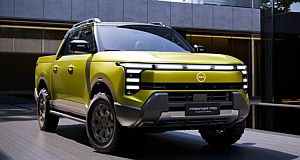

NISSAN has confirmed it will cull the Juke and Pathfinder SUVs from its Australian model range as it turns its attention to a fresh influx of hybrids to be headlined by the Frontier Pro plug-in hybrid ute.
The move is in line with the brand’s long-term strategy to bolster its petrol-electric line-up and meet ever-tightening CO2 emissions regulations while preparing for the new-generation Y63 Patrol that is planned to more seriously take the fight to the rival Toyota LandCruiser.
As part of the model remix Nissan has also ruled out the new Leaf battery electric crossover for Australia, for now at least, saying the model is indefinitely paused and suggesting it is not heading Down Under in a hurry.
Soon-to-depart Nissan Oceania managing director Andrew Humberstone – returning to Europe to be based at the company’s regional headquarters in Paris – said the company’s local line-up had been reassessed with an eye firmly on where the market is heading.
“The strategy was very much future back,” Mr Humberstone said. “What works 15, 10 years, five years from now? And then how do we bridge it?”
This assessment led Nissan to embrace electrification, kicking off with hybrids as the focus.
“We see about 70, 75 per cent of this market is really going to be for at least the next five or so years in the hybrid/E-Power space,” he said, referencing the Nissan hybrid system that uses a petrol engine purely as a generator, leaving electric motors to power the wheels.
“It’ll not be an electric. It will not be an ICE vehicle.”
The shift in strategy means some models will fall by the wayside as Nissan reallocates resources towards hybrid vehicles capable of meeting Australia’s New Vehicle Efficiency Standard (NVES), which has car makers scrambling to balance penalties with credits earned from zero- and low-emissions vehicles.
“In addition, we’re going to have some losers,” Mr Humberstone confirmed. “Juke – not working for us. Pathfinder – not working for us.”
Mr Humberstone said the economics of importing the US-built Pathfinder large SUV no longer stacked up.
“Great product, did very well for us this year as part of a run-out, but very expensive, dollar-based,” he said.
“And most importantly, there’s no future E-Power technology on that US-based product. So it doesn’t make sense for us, regrettably.”
Similarly, the UK-sourced Juke is overshadowed by the larger Qashqai, which will switch exclusively to Nissan’s E-Power hybrid system within months.
Mr Humberstone added that trimming the range would enable Nissan to focus on vehicles with the greatest potential.
“It’s about focusing where you’ve got mass and volume,” he said.
“Products like Juke and Pathfinder … historically, they’ve been a distraction because of the economies of scale and because of cost base and exchange rate.”
Instead, Nissan is concentrating on expanding the hybridised middle of its range – a space currently occupied by models such as the Qashqai and X-Trail.
As well as the all-hybrid Qashqai, Nissan wants to expand its X-Trail E-Power line-up to include more affordable single-motor, two-wheel drive versions to sell alongside the existing dual-motor, all-wheel drive models.
With a new all-hybrid Toyota RAV4 arriving within weeks and increasing hybrid share from key rivals it is a logical move.
“Ideally before the end of this year,” Humberstone said of the two-wheel drive X-Trail E-Power.
At the same time, Nissan still intends to maintain a traditional internal combustion presence in segments where it has strong heritage.
“You need to have your ICE footprint, which we have with Patrol and Navara,” said Mr Humberstone.
“It’s where we’re known – strong brand, strong heritage. We can talk about our Australianness, our longevity.”
However, there is plenty more bubbling away on the hybrid front, even with utes.
The next big step looks set to be the Frontier Pro plug-in hybrid ute developed through Nissan’s joint venture with Chinese partner Dongfeng.
The model has been under evaluation for more than a year and appears tantalisingly close to sign-off for the Australian market.
Nissan has yet to confirm the vehicle for local showrooms, but Mr Humberstone indicated that discussions are well advanced.
“We have JVs with Dongfeng, we have JVs with Renault, we have JVs with Mitsubishi – we have options,” he said of a hybrid ute, while ruling out fitting a Nissan powertrain to the new Navara that is essentially a rebadged Mitsubishi Triton with dynamic tuning specific to Nissan.
“For us, it’s about what makes sense and what serves our market, that provides us with that technology.”
When asked whether the Frontier Pro could potentially wear the Navara badge locally, Mr Humberstone stopped short of confirming the possibility.
“I couldn’t possibly comment at this stage,” he said. “But I think within the next two months we’ll be able to share more.”
The naming question highlights the challenge with Nissan’s future ute strategy, with the new electrified model set to run alongside the existing Navara – albeit a very different beast.
While Mr Humberstone says the company had not yet received final sign-off for the Australian market, “we’re highly optimistic”.
“If you’re still running Navara, then is that a Frontier?” he said. “Or if you’re not running a Navara, is it a Navara? You’re probably running them parallel. So do you have a Navara and a Frontier?”
Regardless of the badge it ultimately wears, the Frontier Pro is expected to represent a shift away from the traditional hard-working formula that has defined the Navara in Australia for decades.
As a plug-in hybrid developed with a Chinese partner, the model is likely to lean more towards lifestyle and technology than the rugged workhorse image long associated with Nissan’s ute line-up.
Given the fast-changing face of the Australian ute market – being shaped by Chinese newcomers such as the BYD Shark 6 and GWM Cannon as well as soon-to-arrive contenders such as the diesel-electric Chery XP31 – evolution may be necessary.
The company’s Australian sales have slipped in recent years as a wave of aggressively priced Chinese brands has surged into the market, reshaping competition across multiple segments.
Nissan also wants to leverage some traditional strongholds, including the off-road space with the Patrol.
The all-new Y63 Patrol is still on target to replace the Y62 late in 2026.
As with its rival LandCruiser, that means a shift from V8 to V6 power, in the Nissan’s case a twin-turbo unit powered by petrol.
But that has not stopped Mr Humberstone forecasting big things.
“Y63 I’m exceptionally optimistic with -– the car is amazing,” he said. “I’m pushing very hard to get extra capacity, extra volume.”