

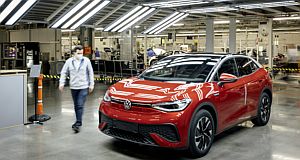

VOLKSWAGEN Group has announced it will cut 50,000 jobs in Germany by 2030 (from a total German head count of about 300,000) as it moves to contain costs amid falling profitability, softer demand in key markets and mounting pressure from global competition.
The cull follows the largest carmaker in Europe reporting its weakest profit result since 2016, with net profit after tax dropping sharply in 2025 to a reported €6.9 billion ($A11.6b), down from €12.4 billion ($A20.8b) a year earlier.
Volkswagen says the “decline” reflects a combination of headwinds including US import tariffs, fierce competitive pressure from Chinese manufacturers and the high cost of restructuring as the company continues its transition toward electrification.
Volkswagen Group chief executive Oliver Blume said the staff reductions would affect operations across Germany and span the broader group, including brands such as Audi and Porsche.
“We are operating in a fundamentally different environment,” he said in a letter to shareholders.
The just announced 50,000 job reduction expands on an earlier agreement reached with powerful German unions, under which Volkswagen had already committed to cutting more than 35,000 positions in a “socially responsible manner” by 2030 as part of a plan to save around €15 billion ($A25.2b).
Like some of Volkswagen’s German rivals it has been hit hard by slowing (particularly EV) demand in China, historically one of its most important and profitable markets.
At the same time, Chinese carmakers are expanding rapidly into Europe, intensifying pressure on incumbent manufacturers across both combustion and electric vehicle segments.
Conditions have also been worsened by US tariffs on imported vehicles, adding further strain to margins at a time when the company is already investing heavily in new electric vehicle architectures, software and battery technology.
Volkswagen Group chief financial officer Arno Antlitz said the business had endured a difficult 2025.
“2025 was shaped by geopolitical tensions, tariffs and intense competitive pressure,” he said.
“The group’s operating margin of 4.6 per cent – even after adjusting for restructuring measures – was not sustainable in the long term.
“We can only realise this if we continue to rigorously reduce costs, leverage group synergies, reduce complexity and thus sustainably increase profitability.”
Despite forecasting a recovery in the year ahead, Volkswagen has warned that more internal discipline will be required.
For 2026, the group is forecasting a core profit margin of between 4.0 and 5.5 per cent, underlining the continued fragility of its earnings outlook.
The company sold around 9.0 million vehicles globally in 2025, broadly in line with the 9.03 million recorded in 2024, though the flat volume result masks uneven performance across brands and regions.
Audi and Porsche have both adjusted aspects of their EV strategies in response to softer-than-expected growth in electric vehicle demand, while the broader group continues to juggle legacy combustion-engine investment alongside future-focused EV and software spending.
Volkswagen’s challenges have also been reflected Down Under where the brand’s sales fell 20.6 per cent in 2025 after declining 16.8 per cent the year before.