


Overview
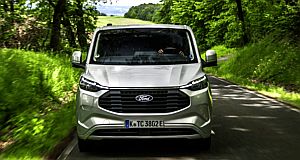
THE Ford Transit is a top seller in Australia, behind only the Toyota HiAce on the light van sales ladder, but it now offers more powertrain options than ever as the Blue Oval looks to capture a fleet audience pursuing decarbonisation.
While a diesel-swigging Transit – or any van for that matter – will get the job done, Ford is betting that a portion of forward-thinking tradies, couriers and fleet managers are ready to swap the clatter of a diesel donk for something a little more current.
The Transit Custom PHEV exists in that sweet spot for those not quite ready to commit to a full-EV option like E-Transit Custom, but who are tired of filling up at the bowser every other day.
See, the PHEV option offers the best of both worlds, capable of driving under only electric power for 54km, or using primarily the petrol engine when the battery is low. Ideally, though, it will use both simultaneously to achieve a ridiculous 1.7l/100km consumption.
Even with a low battery, which means the vehicle operates more like a series hybrid where it’s mostly combustion power with a bit of help from the electric motor, our fuel consumption hovered around 5.7l/100km – well and truly besting the diesel-only model’s 8.0l/100km.
At $67,590 plus on-road costs, it’s around $10,000 more than a diesel Trend LWB model, making it a hard sell for operators that just want to make miles. But, if you top the battery up each night to unlock the 1.7l/100km fuel economy, it’s quite probable you’ll make back the extra dosh across a year or two.
Under the slanted bonnet sits a 2.5-litre four-cylinder petrol engine paired with an electric motor and an 11.8kWh battery. Combined, the system sends 171kW and a beefy 400Nm of torque to the front wheels via a CVT.
It’s an efficient powertrain, with the relatively underpowered four-pot petrol engine, which produces just 86kW on its own, helped along nicely by the electric motor. The electric shove makes for an even more responsive setup than you’d get with a turbocharged engine, meaning there’s always grunt at the ready.
The total torque future is only 10Nm up on the diesel model, but the electric urgency from zero RPM makes the Transit Custom PHEV a pretty potent performer, even when loaded.
Inside, it’s unmistakably Ford, which is a good thing. You get the familiar steering wheel and switchgear from Ranger and Everest models, giving the Transit a more ergonomic interior than other more utilitarian vans out there. The idea is that this acts as a mobile office for operators, and we’d have to agree it achieves that.
It also gets all the active safety technology other modern Ford vehicles receive, with particularly useful (for a van) features like rear cross traffic alert and pedestrian warnings.
Our tester was the Long Wheelbase (LWB) variant, offering a massive 6.8 cubic metres of cargo space, but the Sport SWB PHEV model only loses one cube. Crucially, the battery placement hasn’t compromised the business end of the van, still offering a 1175kg payload and a 2300kg braked towing capacity, which isn’t far off the diesel’s numbers.
Driving impressions
I decided to give the Transit a rather convenient real world test: moving house. This involved six top-to-bottom loads of heavy furniture, gym equipment, car parts, and the multiple runs to the local tip.
The Transit offered all the utility of its diesel siblings but with a far more refined delivery, and across that period I used it largely uncharged yet achieved a 5.7l/100km average. This equates to around 1100km on a single tank, but of course that number shoots up if you plug it in.
Off the line, it’s genuinely punchy. The electric motor provides instant shove, and when the 2.5-litre Duratec engine joins the party, it does so with a uniquely throaty exhaust note that adds a bit of character to the eco-focused powertrain.
It does exhibit a touch of torque steer if you’re too ambitious with your right foot, which adds some drama. It’s a reminder that there’s a decent amount of poke going through those front tyres, though it never feels unrefined or hinders the day-to-day liveability of the van.
On electric power alone, Ford claims a 54km range, but we only managed to get about 30km into our testing before the car flicked over to using a mix of petrol and electric power. I suspect much of that is down to how we were driving, so with gentler acceleration the figure is probably fairly accurate.
Even when the battery is depleted and it switches to regular hybrid mode, it remains remarkably efficient compared to a traditional internal combustion setup. The engine and motor work seamlessly together and beyond hearing the petrol engine ramping up, it’s all fairly imperceptible.
The ride, even when unladen, is commendable for a van of this size. Ford has clearly put the work into getting the Transit Custom range to ride well, with the independent rear suspension really shining when running around empty.
Loaded up, with what had to be at least 500kg during the heavier runs, it remained compliant and that instant torque means we barely noticed a performance drop. Vans really benefit from the instant torque of electric motors when loaded, getting them up to speed quicker.
Is the PHEV worth the extra money over a standard diesel model, though? On paper it isn’t a convincing sell, but in the real world it makes sense. It all works so well, from the powertrain to the suspension, the interior technology, and it’s arguably the best-looking van out there too.
The kicker is you’d need to use this day-in, day-out, putting plenty of kilometers on it to really unlock the electrified benefits. And, you’ll definitely want to plug it in each night to make sure the system is saving as much petrol as possible.