

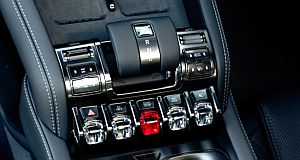

THE Chinese government could mandate the inclusion of physical controls for key vehicle functions in car interiors from as early as next year in a bid to minimise driver distractions and an over-reliance on touchscreens.
According to Car News China, the Ministry of Industry and Information Technology (MIIT) has drafted a revision to Chinese national standard GB4094-2016, which deals with the “Marking of Automotive Control Components, Indicators, and Signaling Devices.”
If adopted, the updated regulations would mandate that key functions such as lighting (including indicators and hazard warning lights), the horn, gear selection, ADAS features, wipers, window demisting, emergency call systems, and the vehicle on/off switch for electric vehicles must be operable through physical controls.
This would counter an industry trend – popularised by the Tesla Model S when it was introduced in 2012 – where the vast majority of vehicle functions are handled through dashboard-mounted infotainment touchscreens.
Under the proposed changes, physical controls must also have a minimum surface area of 10mm by 10mm, be in a fixed position, provide haptic or auditory feedback, be operable blind, and remain functional in the event of a vehicle power loss.
The Australasian New Car Assessment Program (ANCAP) and continental counterpart Euro NCAP – while not regulatory bodies like the MIIT – share a similar sentiment.
As of this year, Euro NCAP’s safety testing protocols consider “the placement, clarity, and ease of use of essential controls – including the availability of physical buttons for commonly used functions, which consumer feedback suggests can reduce distraction”.
ANCAP’s parameters also received a similar update for this year, meaning the intuitiveness of key vehicle controls could have an impact on a model’s ability to achieve a five-star safety rating.
Touchscreen controls are not the only vehicle feature that the Chinese government has recently sought to crack down on.
Earlier this month, it was announced that electrically operated flush door handles without a mechanical override would be banned in China from January 1 next year.
One-pedal driving – which uses regenerative braking to slow electric vehicles down when the driver lifts their foot off the accelerator – will also be banned as a default mode in China on the same date.
Yoke-style steering wheels, such as those featured on the Tesla Model S and Model X Plaid variants, the Lexus RZ, and the incoming Mercedes-Benz EQS in some markets, will also fall foul of new Chinese regulations.
The proposed regulation change regarding the inclusion of physical controls would come into effect for new vehicles from the July 1 next year if adopted.