


Overview
IT MAY surprise you to read this, but the quickest accelerating production Subaru model ever built is nt arally-inspired STI badge-wearing monster, but instead a large electric SUV.
That’s right, with a quoted 0-100km/h time of around 4.5 seconds, the new Subaru Trailseeker – badged as the eOutback in the European, British, and the Singaporean markets – accelerates quicker than any production car ever released by the Japanese brand, including the previous generation WRX STI.
This performance comes courtesy of a dual-motor symmetrical all-wheel drive powertrain – used in both the entry-level Trailseeker AWD (priced at $63,990 plus on-road costs) and the range-topping AWD Touring ($69,990 + ORCs) – comprising two electric motors, producing 167kW/268Nm each, with a combined system output quoted at 280kW.
Electricity is sourced from a 74.7kWh lithium-ion battery, good for WLTP driving range of 533km in the Trailseeker AWD and 488km in the Touring AWD.
Energy efficiency is rated at 15.4kWh per 100km in the base Trailseeker, while the Touring model’s claimed figure sits at 16.8kWh/100km.
The battery supports 7kW single phase and 11kW three phase AC charging and 150kW DC charging, the latter allowing for 10-80 per cent recharge times of around 30 minutes.
The Trailseeker is currently the largest member of Subaru’s now three-strong electric SUV family in Australia.
Like its Solterra and Uncharted stablemates, the Trailseeker rides on the e-Subaru Global Platform, which it also shares with the Toyota bZ4X (under which it is referred to as the eTNGA platform) as well as its closely-related, rugged, wagon-bodied relative, the bZ4X Touring.
The Trailseeker can accommodate 609 litres of cargo with the rear seats up and 1230 litres with the rear seats down in the entry-level AWD model, and 595 litres with the second row up and 1216 litres with the seats folded in the tops-spec AWD Touring.
Neither are offered with a frunk (front boot).
Despite being the bZ4X Touring’s twin, Subaru says that they’ve still been able to inject its own identity into its development when it comes to all-wheel drive and suspension tuning, as well as the inclusion of the X-Mode Snow/Dirt and Deep Snow/Mud driving modes.
In any case, the Trailseeker – and indeed the bZ4X Touring – finds itself in competition with both mid-size and large electric SUV such as the Tesla Model Y (from $58,900 + ORC), BYD Sealion 7 (from $54,990 + ORC), Zeekr 7X (from $57,900 + ORC), the Deepal E07 Multitruck (from $64,900 + ORC), and the KGM Torres EVX (from $52,990 driveaway).
Kicking off the range, standard exterior features on the Trailseeker AWD include 18-inch alloy wheels, roof rails, dusk-sensing and self-levelling LED headlights with auto off, LED daytime running lights, rain-sensing front wipers, a power tailgate with kick-sensor, and heated and auto-folding wing mirrors.
Inside you’ll find a 7.0-inch digital instrument cluster, a 14.0-inch infotainment touchscreen with wireless Apple CarPlay and Android Auto, black synthetic leather seats, an eight-way power-adjustable driver and front passenger’s seat, heated front and rear outboard seats, a heated leather steering wheel, USB-C charging ports (two in the front and two in the back), two wireless phone chargers in the front, a centre-folding armrest with cupholders, interior ambient lighting, and a six-speaker sound system.
Standard safety features on the Trailseeker include dynamic radar cruise control, road sign assist, tyre pressure monitoring, lane departure alert, lane tracing assist, emergency driving stop, a driver monitoring system, a 360-degree camera, adaptive high beam, blind-spot monitoring, front and rear parking sensors, rear cross-traffic alert, and dual front, dual front side, dual curtain, front seat centre and driver’s knee airbags.
The Trailseeker features a five-star ANCAP safety rating.
Over the base Trailseeker, the Touring AWD receives 20-inch alloy wheels, optional two-tone paint (available for $1200), blue and black leather accented seats, advanced park assist, auto-dipping and position memory door mirrors, a panoramic glass sunroof with an electrically retracting sunshade, a 220V/1500W vehicle-to-load (V2L) power outlet, a dual memory function for the driver’s seat, ventilated front seats, and a 10-speaker harman/kardon sound system.
Premium paint is available for the Trailseeker as a $660 option.
Neither version of the Trailseeker is equipped with a spare wheel. Instead, it is offered with a puncture repair kit.
The Trailseeker is offered with a five-year/unlimited-kilometre warranty, an eight-year/160,000km high-voltage battery warranty, and 12-months of roadside assistance.
A five-year/75,000km capped-price servicing program is also offered with the Trailseeker, with intervals arriving every 12 months or 15,000km.
Prices for each service range between $128.87 and $300.85, with the total cost over five years coming to $984.18.
Driving Impressions
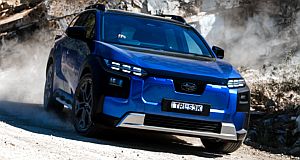
Visually, the Subaru Trailseeker stands out from many of its modern SUV contemporaries with its robust, boxy, wagon-style aesthetic. This is no solely-aero-focused ultra-modern blob.
We find that its rugged look is only further enhanced by its black plastic wheel arches, its side-skirt design, and its roof rails.
For anyone who’s spent time behind the wheel of a recent example of its Subaru Solterra stablemate (or its Toyota bZ4X cousin), the Trailseeker’s cockpit will feel familiar with an identical layout to its relatives.
During our time with the Trailseeker, we appreciated its mix of physical and digital controls, which include buttons on the dashboard, physical climate control buttons, and media volume dials (the former containing a digital display integrated with the infotainment touchscreen), intuitive steering wheel controls, and paddle shifters for managing its five levels of regen.
Not all its controls are physical though… While the climate control temperature is handled with dials, the seat heating (and ventilation in the top-spec Touring), fan speed, and air direction controls are all contained within the screen. However, because these controls are so large, they’re not a pain to interact with.
As for the rest of the screen, it’s well laid out and easy to navigate largely due to its side navigation bar.
Looking ahead, while the digital instrument cluster does the job it’s perhaps a little cluttered and does look slightly dated. We suspect its interface may look quite dated in a few years’ time.
Storage options in the front row are solid with the EV-hallmark cleared out space beneath the dashboard, two cupholders, and a centre console armrest storage compartment that opens bi-directionally.
Interestingly, the Trailseeker doesn’t have a conventional glove box, with the owner’s manual instead placed beneath a removable shelf in the centre console armrest storage. While glove enthusiasts may find this disappointing, it did prompt us to recall how often we use the glovebox…
Amenities are solid as well, particularly the dual wireless phone chargers, which worked impressively reliably during our time with the Trailseeker.
Forward visibility is strong with a massive windscreen, thin A-pillars and windows that look beyond the wing mirrors, and rear visibility also very good.
When it comes to the cabin’s look and feel, the Trailseeker was fine but not exceptional. The synthetic leather upholstery in the base Trailseeker and the leather upholstery in the Touring are both pleasant, but there’s a few scratchy plastic touchpoints.
As much as Subaru has tried to spruce up the cabin with the top-spec Touring’s blue and black interior trim, it’s hardly what you’d call visually evocative. Ultimately, it does the job.
In the back seat, you’ll find massive knee room and decent headroom. Second-row passengers are hardly forgotten about when it comes to amenities too, with access to a centre-folding armrest with cupholders, two USB-C ports, rear air vents and, most impressively of all, heated outboard rear seats as standard.
However, we found the rear bench’s under thigh support somewhat lacking – a problem that crops up in many EV back seats – and, because it’s difficult to fit your feet underneath the seat in front, its position dictates how far you can stretch your legs out. These two characteristics made it slightly more difficult to get comfortable on an extended back-seat journey from Mollymook to Sydney.
Between the two variants, the standard model has the highest quoted storage space. We found its boot fairly spacious, with its practicality further aided by its underfloor storage and adjustable floor. However, where EV owners may expect to find a “frunk” (front boot), you’ll be met with a mess of wires and componentry.
During our time with the Trailseeker, we drove from Canberra airport to Mollymook via Pheasant Wood Circuit and Jerrawangala National Park.
The Trailseeker made an immediate impression with its explosive straight-line performance.
While it’s not strictly a performance car, even in its standard driving mode it certainly isn’t slow. Its accelerator pedal is extremely responsive, even by electric vehicle standards, and its initial acceleration phase is a shock to the system.
We found the Trailseeker’s grunt particularly useful in overtaking scenarios. Need to dispatch a truck on a single carriageway? The Trailseeker has you covered.
The Trailseeker has five levels of regen – adjustable via the steering wheel paddles – and while it is not capable of one-pedal driving, each level feels incrementally different, and even the highest level of regen allows for smooth operation.
Its ride feels quite well-tuned for Australian roads. It’s comfortable while not coming at the expense of body control. It still communicates what the surface is like beneath you without feeling invasive. It also doesn’t seem to suffer even while riding on the Touring’s larger 20-inch wheels.
The steering has a weighty on-centre feel but isn’t necessarily the most engaging or pin-point accurate.
From the front seat at least, wind and tyre noise is kept to an impressive minimum. However, we found the tyre noise slightly more pronounced in the second row, making conversations in the front row a little difficult to hear.
The Trailseeker’s ADAS features are very non-intrusive. There are no untoward beeps or bongs to report. The dynamic radar cruise control system works as expected and is easy to interact with via the steering wheel controls. Even if the systems aren’t to your liking, they can easily be adjusted via the infotainment touchscreen.
During our testing we recorded energy efficiency after five different drives which varied somewhat in length and the types of roads as well as the variant which we were driving.
Our lowest recorded consumption figure was 13.5kWh per 100km while the highest was 18.9kWh/100km. However, on three occasions we actually recorded numbers better than those claimed by Subaru, with the Touring posting 15.15kWh/100km and 15.87kWh/100km while the 13.5kWh/100k, recorded in the base model is nearly 2kWh/100km more efficient that the manufacturers claim.
As mentioned, our Trailseeker drive day took us to Pheasant Wood Circuit. Again, the Trailseeker isn’t marketed as a performance car and, as such, we believe that we may be among the first and last people ever to track one of these two-tonne electric SUVs.
However, while the Trailseeker didn’t exactly feel at home on the racetrack, it wasn’t entirely out of its depth either. When pushed, it’ll understeer a bit and you’ll find yourself conscious of its considerable mass moving around. But to its credit, it holds on.
We also took the Trailseeker onto a gravel track in the Jerrawangala National Park. This exercise was far from serious off-roading but with its solid ground clearance, the Trailseeker negotiated some considerable potholes with ease.
Overall, the Subaru Trailseeker is an impressive all-rounder.
It’s quick, it’s practical (for the most part), it’s pleasant to drive, has good range, a solid list of standard equipment, its cockpit is quite user-friendly, its ADAS systems are pleasantly non-intrusive, and while we haven’t had the opportunity to properly drive it off-road and put its X Mode system to the test, it seems to be able to handle itself when taken slightly off the beaten track.
Its rugged vibe and wagon form factor will also likely appeal to certain buyers.
However, some of the cabin plastics leave a bit to be desired, the rear bench isn’t as supportive as it could be, there’s no spare wheel, there’s no frunk, V2L isn’t a standard feature, and the top-spec Touring model loses considerable range and some boot space – at least based on its claimed figures – compared to the entry-level variant.
Ultimately, the Trailseeker has a lot to offer, and if these appeal to you, and you’re in the market for an electric SUV, it’s certainly worth a look.