

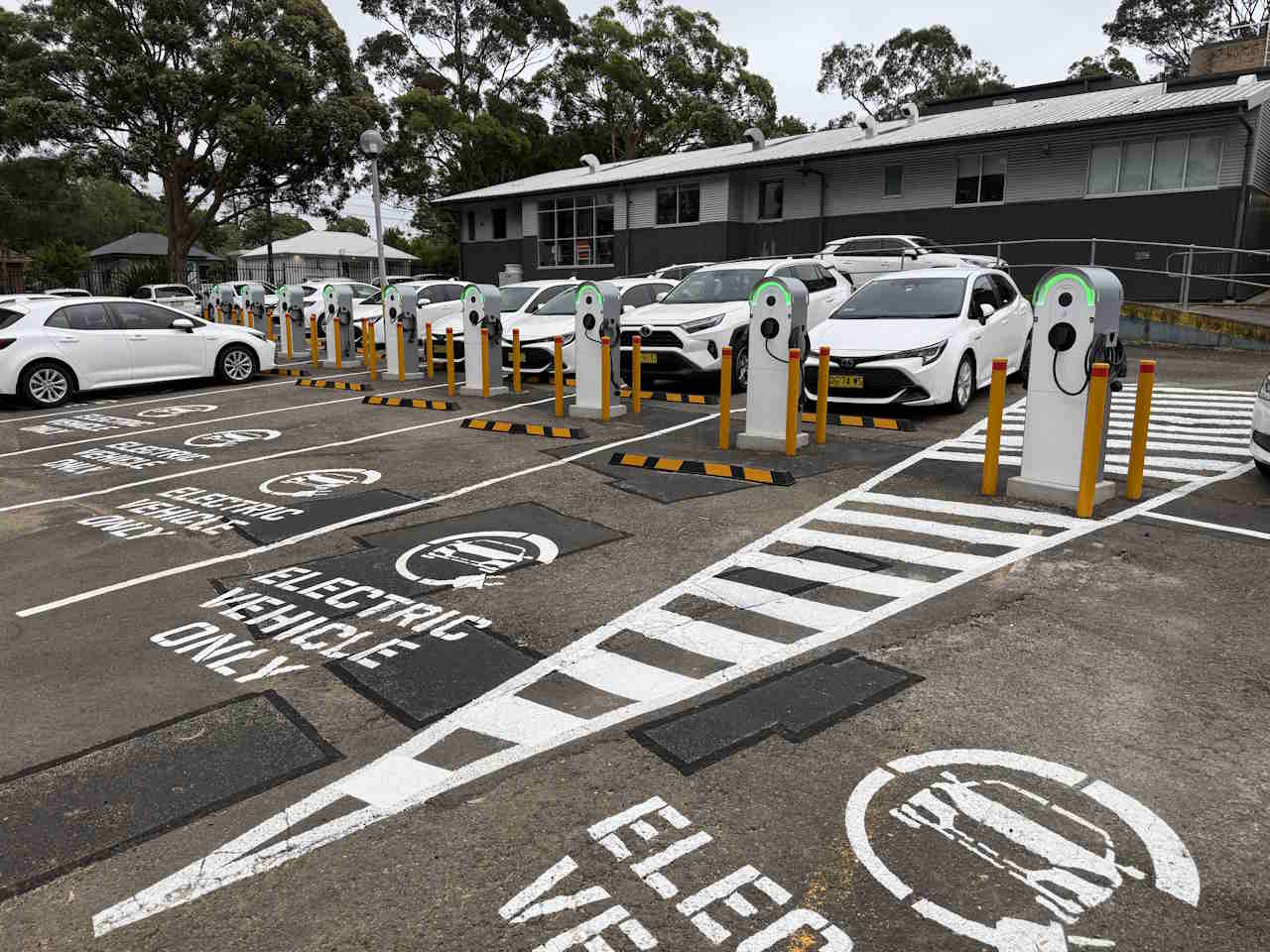
Letting employees charge their company-owned electric vehicles (EVs) at home is the fastest and cheapest way to switch a fleet from fossil to electric fuel, according to an early report from a government-backed trial.
But home charging also turns out to be the pain point making fleet managers and companies nervous, because now they’re relying on the wiring of black boxes of hundreds of private residences.
“Residential charging has proven to be the most practical, cost-effective, and scalable foundation for fleet electrification,” charging operator Jet Charge says in its first report on a $12 million Australian Renewable Energy Agency (ARENA)-funded project.
Commercial vehicle fleets have long been seen as key to the transition to EVs, as they put affordable cars into second hand markets and as bulk vehicle users they lead in creating more charging infrastructure.
But the charging issue has proved to be a sticking point.
Jet Charge found that more than 80 per cent of fleet EVs are garaged at drivers’ homes overnight, and that’s requiring a rethink in how fleets are viewed inside organisations.
The company was funded under ARENA’s Driving the Nation program to investigate subscription charging-as-a-service (CaaS) for fleets. What it found is that handing over the ‘refuelling’ aspect to a charging provider helped navigate the safety and compliance worries around home charging.
“It requires organisations to rethink infrastructure ownership, cost structure, and operational responsibility simultaneously,” says the first report.
“What these fleet operators told us is that the turning point was recognising the problem was not the technology but the ownership model. When the service provider [CaaS businesses such as Jetcharge] owns the [charging] hardware, is responsible for every installation, and monitors the network on an ongoing basis, the compliance obligation does not pass to the fleet operator.
“That shift, from owning a distributed asset network to accessing it as a managed service, is consistently what our customers tell us makes the broader program viable.”
The report makes it clear letting people charge their company cars at home is a no brainer.
Home chargers can be installed within a month, compared to three months for a workplace project, slower 7-22 kilowatt hour (kWh) home charging is easier on batteries, and even paying staff a rate of 45c-52c per kWh for charging works out cheaper than petrol or diesel.
However, home charging also involves letting go of control over the charger network: companies can’t easily inspect nor have direct control over home chargers, nor have any insight into the writing standards inside their employees’ homes.
“Australia’s largest insurer [IAG] notes that fire risk from lithium-ion battery charging is effectively eliminated when an undamaged EV is charged correctly using appropriate equipment, but the operative phrase is charged correctly. The risk is not the vehicle. It is the installation behind it,” the report says.
But employer duty-of-care obligations mean portable charging solutions are “consistently” rejected by corporate fleets because they can’t control the device once it’s in a private home.
The other issue the Jet Charge report uncovered was total cost, as companies focused only on dollars and cents, rather than sustainability as well, are finding that the price of switching to EVs is higher than expected.
“In practice, whole-of-life fleet costs extend well beyond fuel versus energy savings to include insurance premiums, parts availability and repair times, resale value management, and battery health at end of lease,” the report says.
“Fleet operators who approach BEV transition with a break-even mindset rather than expecting immediate savings are consistently better placed to execute, as they build in the margin needed to absorb these variables and maintain a positive driver experience.”
Sign up for The Driven’s free daily newsletter and get the latest EV news and analysis delivered straight to your inbox.