

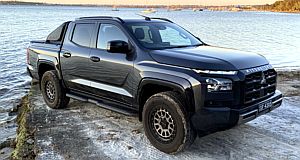

Overview
Product cloning used to be an automotive craze in the previous century, with ‘badge engineering’ a chance for a so-so brand to pick up another model thanks to a donor’s inability to sell its own version.
So among the local manufacturers, we had Holden-Toyotas and Ford-Nissans – and others – to pad out showrooms and sell an extra few thousand of what were very average cars. These included the Ford Telstar and Mazda 626, Holden Apollo and Toyota Camry, and Ford Falcon utility and Nissan Ute.
The concept is back. In simplistic terms, the Mitsubishi ASX is the Renault Captur and the Mitsubishi Triton ute is the Nissan Navara.
That extends to the top-line, performance-themed Mitsubishi Triton Raider. This is the second re-engineering project by Australian automotive specialists Premcar (after the Nissan Navara Warrior) and will be followed by the Chery Stockman – all indicative of the engineering company’s reputation to make existing 4WDs perform better while meeting strict OEM budgets.
Aside from the fact that Nissan and Mitsubishi are linked by their corporate alliance, the respective Navara and Triton are now technology clones, sharing chassis and drivetrain details.
Premcar has applied its engineering to both the Navara and Triton, but although they’re almost twins, there are differences in the degree of modifications and the targeted audience.
Premcar says the Navara buyer doesn’t want all the same things as a Triton buyer, hence the different focal point. It adds that Mitsubishi buyers prefer a subtle look, so the Raider styling is less aggressive than the Warrior.
The Triton Raider costs $74,990 plus on-road costs, a premium of $9000 on the Triton GSR on which it is based. That’s a hefty margin.
The off-road agility boosted by Premcar’s enhanced suspension package is an alluring reason to tick the Raider over the GSR. Macho looks, helped by the sports bar and tough grille and skid plate, add more appeal.
The trick is that Mitsubishi has recently upgraded the GSR’s suspension, employing Yamaha shocks and links. Does this make the GSR ride and hit the outdoors as hard as the Raider? You’ll have to wait until we test one.
The Raider joins the trick members of rival ute-makers, including Ford’s V6-powered Tremor ute ($75,090 plus costs); the Isuzu Ute D-Max Blade ($80,900 plus costs), and the Nissan Warrior at $71,643 (plus costs).
Clearly a ute is a three-box shape and styling is pretty restrictive and unlikely to wear the penmanship of a leading auto designer.
The Raider is a Triton, with its elevation to the top shelf indicated by the revised grille that has a hexagonal pattern in all black, the higher road height (up 15mm at the front, 25mm at the rear) and the sports bar and fabric tonneau cover.
More attention is captured by the ROH wheels which are a one-off design for the Raider, using more perforations and finished in a titanium paint colour. The Raider gets Bridgestone Dueler AT/200 285/60R18 tyres, in contrast to the Cooper 275/70R17 rubbers on the Nissan Warrior.
Inside there’s ‘Raider’ logo on the front seat head restraints and a centre-console badge. The rest of the interior looks great and is carried over in appearance and features from the GSR.
Cabin room is good, with space for five adults. There’s also two child seat tethers (no central anchor).
There’s enough of a difference to make the Raider stand out to enthusiasts, but possibly needs more of an upgrade to make buyers extend their wallets that extra $9k.
Note that Premcar said Mitsubishi buyers preferred a subtle approach to styling which implies that its Warrior owners opted for more in-ya-face features.
Raider also gets a tonneau cover for the tray, against the more popular – but considerably less functional – hard roller cover and electric retraction.
The fabric cover also means there’s full access to the tray when removed, allowing for lots of room and tie-down points (helped by the sports bar) for awkward cargo including bikes. The tray is a decent size, measuring 1555mm long by 1545mm wide, with 1135mm between the wheel arches.
Mitsubishi has a five-star rating (2024) for its Triton that carries over to the current Raider. It earns this through an autonomous emergency braking system (including in reverse), cycle and pedestrian detection, road junction detection, lane keeping, lane departure warning, emergency lane keeping, speed-sign recognition, driver distraction monitor and eight airbags.
ANCAP gave it an 86 per cent rating for adult occupant protection; 89 per cent for child occupant protection; 73 per cent for vulnerable road user protection; and 70 per cent for safety assist features.
ANCAP also said the ute has top tethers for child seats only in the outer rear seats.
Mitsubishi has a 10-year, 200,000km new-car warranty, roadside assistance and capped-price service program. However, the vehicle must be serviced at an authorised Mitsubishi dealership, otherwise the warranty (and roadside and CPS program) reverts to a five-year or 100,000km term.
Roadside assist is renewed after one year and, if the car remains serviced at Mitsubishi, will extend to 10 years.
Its capped-price service goes to 10 years or 150,000km which will cost $7023, or average $702 a year. It will cost $1467 for the first three years; and $2705 for the first five years. The service intervals are 12 months or 15,000km.
Driving Impressions
Given all the hardware and engineering acumen poured into the Raider, you’d expect something really special. Along the lines of the first Ranger Raptor and its clever Fox shock suspension that could iron out some gnarly off-road bumps.
The Raider is good, certainly much better than the plain-Jane Tritons in the on-road and off-road ride and handling department. It’s not quite Raptor and despite what anyone may first wish, that wasn’t the goal.
Instead, the Raider has tangible improvements in on-road feel, bump-resistance to road irregularities, plus positive tracking through the bends. It makes for a better Triton and one that – given its easier driver control and more positive manners – should be available for all Triton buyers.
There is still some suspension jarring over seriously pitted roads, mainly from the rear. Piling on some extra kilos in the tray softened most of that harshness, showing that the leaves respond favourably to being weighted.
In the dirt the same applies. The front feels well planted and absorbs bumps well, while the rear doesn’t disguise its willingness to hop (unladen) over the bigger bumps.
The Raider is up 25mm (front axle) on the GSR and its ground clearance is now 243mm. Just as a point of reference, the Warrior is up 40mm from stock and has a 260mm clearance.
This increased ground clearance for the Raider is welcome, not only for its ability to clear the centre of off-road tracks but also to help lift the ramp-over angle which is a serious helping hand to overcome the long 3130mm wheelbase.
Other than a gripe about the rear drum brakes – okay, they work fine but discs are preferable from a service perspective and for more consistent performance when wet or hot – there’s nothing in the chassis that scores poorly.
Except the drivetrain. Much of the underbody stuff is Mitsubishi and for 2026, this also slides under the latest Nissan Navara.
The bi-turbo 2.4-litre four-cylinder engine is Mitsubishi and is rated at 150kW at 3500rpm, with torque of 470Nm at 1500rpm through to 2750rpm.
They’re solid numbers. But they don’t feel impressive on the road. A lot of that is due to the response underfoot, particularly off the mark, where the Raider (read Triton and Navara) almost feels like it has to take a few extra breaths.
Its revs build leisurely, aided by a seven-speed torque-convertor automatic that is a strong and enduring unit but has all the spark of a sitting US president.
The effect is a subdued, almost boring road trip that likely suits long-distance drivers who don’t need any driving stimulation. Indeed, the Raider’s touring legs are very good, with a low 1600rpm engine rate at 100km/h and smooth and quiet engine operation.
It’s also one of the more comfortable utes, with seats that are supportive and thanks to a relatively low seat height and the aid of the side steps, easy to enter and leave. Less agile owners, who may look at the Raider as a caravan tow vehicle, could do worse.
Mitsubishi claims 7.7 litres per 100km and the test here recorded 8.7 L/100km, helped by some trips to a coastal track and a crazy period of congested suburban roads that triggered the Raider’s auto stop-start to save fuel.
The Raider draws from a 75-litre tank – so a range of about 975km – and also needs AdBlue (for the exhaust emissions) which is a 17-litre tank. AdBlue is generally less than $2 a litre at service stations.